
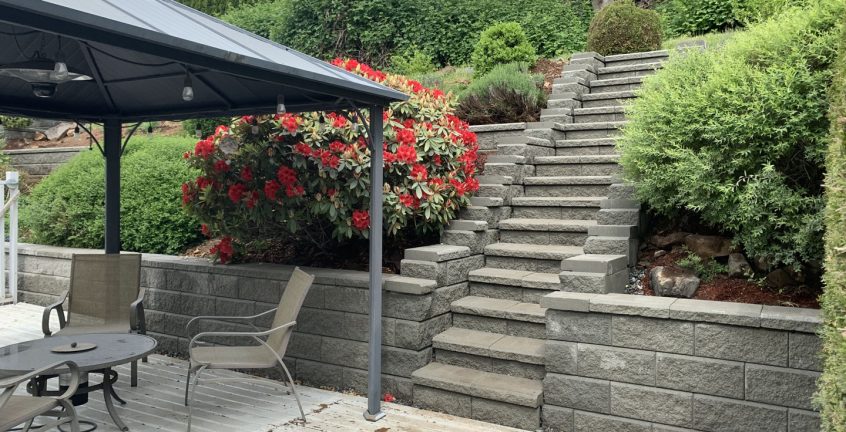
Retaining walls on property lines can be a costly and contentious issue, especially when replacement is necessary. As such, both neighbours need to understand the costs involved, and more importantly, who is responsible for paying those costs. In most cases, this results in shared responsibilities; however, it’s best to understand key guidelines that can determine the ultimate responsibility.
Let’s review the key information and guidelines for who bears responsibility for the replacement of a retaining wall along a shared property line.
Replacement Responsibility: Retaining walls on Property Lines
There are two main considerations that impact who is responsible for the cost of a retaining wall on the property line:
- Are you obligated to construct or contribute to the construction of a retaining wall?
- Does your neighbour possess the common law right to receive lateral support from adjoining land?
A duty can be generated in various scenarios, such as when a retaining wall is necessary for lot grading or if there’s an agreement to construct a barrier between two properties. This could transpire through a contractual arrangement at the time of sale. So essentially, this is something you should ask and consider when you are buying the property.
Generally speaking, there is a legal precedent that allows landowners to seek aid from their neighbours when they need help supporting or preserving their land from spilling onto the neighbours. In turn, this places an obligation on landowners to ensure that said support remains intact. Therefore, you can ask, but if your neighbour is unable or unwilling to share the responsibility, that is their right.
Communicating with the Neighbour
Whether you decide to manage this project yourself or outsource a retaining wall installer, it is best to consider the endeavour holistically and treat it like a business deal. Establish clear communication, come up with an effective plan of action, and get every detail in writing before initiating construction.
Here are common considerations and tips that are recommended to follow:
- Start by talking with the neighbours who live in adjoining properties.
If you want to build a retaining wall on a property line, you should speak with your neighbour first. Construction will likely affect both homeowners’ land use during time of construction.
- Gather all personal information of everyone involved and discuss the type of retaining wall you’d like to see installed on the property line.
It is not guaranteed that you and the neighbour will agree on the same plans or material used. That being said, this is a great opportunity to make a deal on the type of wall constructed and splitting costs, as a retaining wall can add significant aesthetic beauty and property value. Personal information should include: Legal Name, Email, Address, and Phone Number.
- Address them in written form, either by mail or email and keep copies of the interaction.
After communicating about the desired project, it is good practice to keep written interactions when dealing with any projects that can have legal repercussions. It can be difficult to legally dispute something when only verbal permission has been given.
- Outline a cost estimation for the project.
When taking on this project yourself, remember to incorporate the materials and supplies needed, as well as any associated mobilization charges, time costs and labour into your evaluation so that all parties understand the extent of it.
At this time, it’s vital to discuss the payment responsibility and intent. If hiring a local retaining wall company, it is essential to always review and confirm the details of their written estimation if the project is being paid by both parties separately. Ensure that all persons involved in the project are identified with cost responsibility for each task, and that written consent for project commencement is documented.
- Get, or Pay, a Deposit
Whether you are performing the retaining wall installation yourself or hiring a retaining wall installer, by receiving or paying a deposit, the intent to purchase has been established and proof of funds is assumed; essentially, a good-faith payment. This means that all parties are serious about buying, and you can go ahead with the purchase without worrying that they might back out. The payment helps tie them to the project.
This is a crucial step when dealing with multiple neighbours, as you may not be able to afford the project without the neighbour’s involvement, but will be on the hook for the full payment if the other parties are not legally tied to the project.
TIP: It’s highly recommended to exercise caution when paying a deposit to any retaining wall installer. If they are unable to provide you with a documented estimate, contactable references or reputable testimonials, and demonstrate proficient knowledge of local regulations about retaining wall construction, then do not pay the deposit.
- Call before you dig!
To safeguard yourself from potential danger or additional costs, contact BC 1 Call at 1-800-474-6886 to find out what’s buried on your property. Anything from pipelines and telecommunications cables to water and sewage lines or electrical wires may be concealed underground! Accessing this knowledge beforehand is key to ensuring a safe project.
Liability – Who’s Responsible?
It is the sole responsibility of the homeowner to acquire consent for the retaining wall installation, even when hiring a local company to install the wall. This is because they are performing work on your behalf.
Unless a wall is built with a permit, where you may sign over responsibility to a company to act on your behalf when dealing with the city, you are ultimately responsible for any damages or unforeseen costs. If one homeowner takes on responsibility for a project involving a neighbour who has not legally consented, then they will be held accountable if any deposit has been provided or contract has been signed.
When you plan a project, it is very important to remember that if the plan does not follow the rules that local regulations and building codes have , any homeowner involved will have to pay any penalties that are connected with not following the rules.
Any professional retaining wall installation company would be able to guide you through local bylaw regulations.
Conclusion
Retaining wall installation can be a challenging endeavour, but these tips will help you get started on the right track. Once you have considered all the necessary steps to complete this project legally and safely, it’s time to put your plan into action and give the go-ahead.
Remember to establish open communication, outline the project cost estimation, discuss payment responsibility, and keep track of communications with written documentation. Ensure all parties involved in the project are identified and the cost is properly allocated.
Lastly, remember that you, as the homeowner, are ultimately responsible for any damages or unforeseen costs, so call before you dig and know your municipal regulations regarding your project. Following these steps will ensure a smooth retaining wall installation process.
Need help with your project? Contact Frontline Fencing today to schedule a free estimate.
If you’re looking for a reliable and cost-effective way to install fencing on your property, contact Frontline Fencing today! Get in touch with our experts now, schedule a free estimate, and find out why Frontline Fencing is the go-to choice! Be sure to ask us about our range of fencing solutions when you call!
FAQs
What should I do if my neighbour doesn’t want to pay for the retaining wall installation?
If your neighbour refuses to acknowledge the responsibility of replacing a deteriorated retaining wall that’s impeding on your property, you may need to take legal action.
How can I get a hold of the homeowners of adjoining properties to begin planning my retaining wall installation?
If your neighbour is not the homeowner, leaving mail with the title of “The Landlord of” or “The Homeowner of” (followed by the address) at adjoining properties is typically reliable, but there’s no guarantee on how long it will take to get through. Another approach would be to check public records for a home’s ownership details.