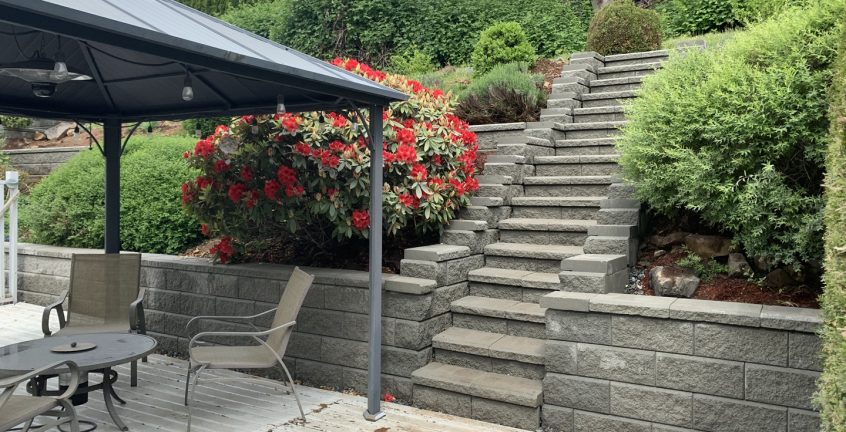
If your property has a sloped yard, soil erosion or limited outdoor space, you want to consider adding a retaining wall. It’s a popular choice amongst homeowners dealing with these issues. Beyond creating more usable space in your yard, adding a retaining wall can also be a smart way to improve drainage.
Truly, the right wall can transform your yard into a functional and aesthetically pleasing extension of your home while also providing long-term stability for your property. Let’s explore the three most common residential retaining wall installations. Each of these styles offers unique benefits, but choosing the best one depends on your property layout and needs.
Here are the three most popular residential retaining wall styles, explained
Retaining walls not only offer functional support but also contribute to the overall aesthetics and value of your property. Let’s discuss the most popular ones.
-
Modular Block Walls or Gravity Walls
- Modular block wall systems, like the popularized Allan Block (e.g. Allan Block), are classic examples of gravity walls. Stacked blocks (often interlocking) hold back soil; the mass of them is what holds back matter and water. Commonly built using concrete blocks or natural stone, this type of wall is fairly easy to install and rarely needs more reinforcement, and thus is popular amongst most homeowners.
- Modular, or gravity, walls are best for short to moderate sloped properties. You do need to have a strong, foundational and stable base to start with, or apply shallow concrete footing to get started. Then the blocks are placed in a tiered fashion. They are visually appealing and can be an ideal choice in curved or decorative designs.
- Tip: Typically, gravity walls like Allan Block may require reinforcements, and in some cases engineering, for walls that exceed 4ft in height. Check local building codes or ask your retaining wall specialist for more information. Reinforcements may include geogrid for soil stabilization, specific compaction levels and backfill material, and water management systems.
-
Cantilevered (Reinforced) Retaining Walls
- A cantilever retaining wall (or reinforced wall) is made entirely of concrete. It’s highly reinforced due to its slightly complicated shape and structure. Cantilever walls are shaped like an “L” or upside-down “T”. They have a vertical wall (called a stem) connected to the horizontal base, which is then divided into a “heel and toe”. It’s the heel that stabilizes the weight of the soil, and the pressure from the land is essentially counteracted.
- Cantilever walls are ideal for medium to tall structures and where space is very limited. It’s commonly seen on properties with steep slopes. Proper engineering and a solid foundation are essential for stability and safety, so a professional is not only needed, but the best choice to ensure it’s engineered to be made as strong as possible.
-
Anchored Retaining Walls
- Anchored retaining walls are often requested, or suggested, when the property or project location has extremely small working area but the weight of the soil or earth is very high. Of all the walls, this is the strongest and needed to hold back soil effectively. There are cables and rods anchored into stable ground, rock, or house footings. This provides strong lateral support and will prevent the wall from buckling under pressure.
- Anchored walls may look thinner than the other options, which is why they can be installed in very small or tight spaces. These are best suited for very tall buildings, extremely sloped lands or terraces, tight walkways between residential homes, and properties with embankments.
How to Choose the Right Retaining Wall for Your Home
The type of wall you choose for your property depends on your landscape or design needs. Gravity walls or modular walls are best for low-sloped lands where you need durability, or when a curved shape is required. If you live in an area of higher elevation or want a more finished look, then a cantilevered wall will provide the strength needed. Anchored walls are ideal in tight spaces or when supporting heavier loads.
Elements such as soil type, drainage needs, as well as the elevation of your property all affect the choice of wall that best suits your needs. Proper drainage is essential to reduce pressure buildup behind the wall. If you find that water is not draining properly off your land, and you have pools of water, this is something you must consider in your wall structure.
Get Privacy, Safety, and Structural Support
While fences often focus on privacy or safety, retaining walls carry structural responsibility and must be carefully built to support soil and prevent damage.
At Frontline Fencing, we do more than just fences. Our team helps homeowners design and build retaining walls that suit their property’s layout, soil conditions, and style. From gravity walls for garden terraces to reinforced or anchored systems for steeper grades, we offer expert guidance, permitting support, and professional installation you can trust.
If you’re looking for a reliable and cost-effective way to install fencing on your property, contact Frontline Fencing today! Get in touch with our experts now, schedule a free estimate, and find out why Frontline Fencing is the go-to choice! Be sure to ask us about our range of fencing solutions when you call!
For expert advice on your project, contact us today at 778-347-9473 or schedule an in-person consultation by clicking here.